
For professionals
How the measurement works
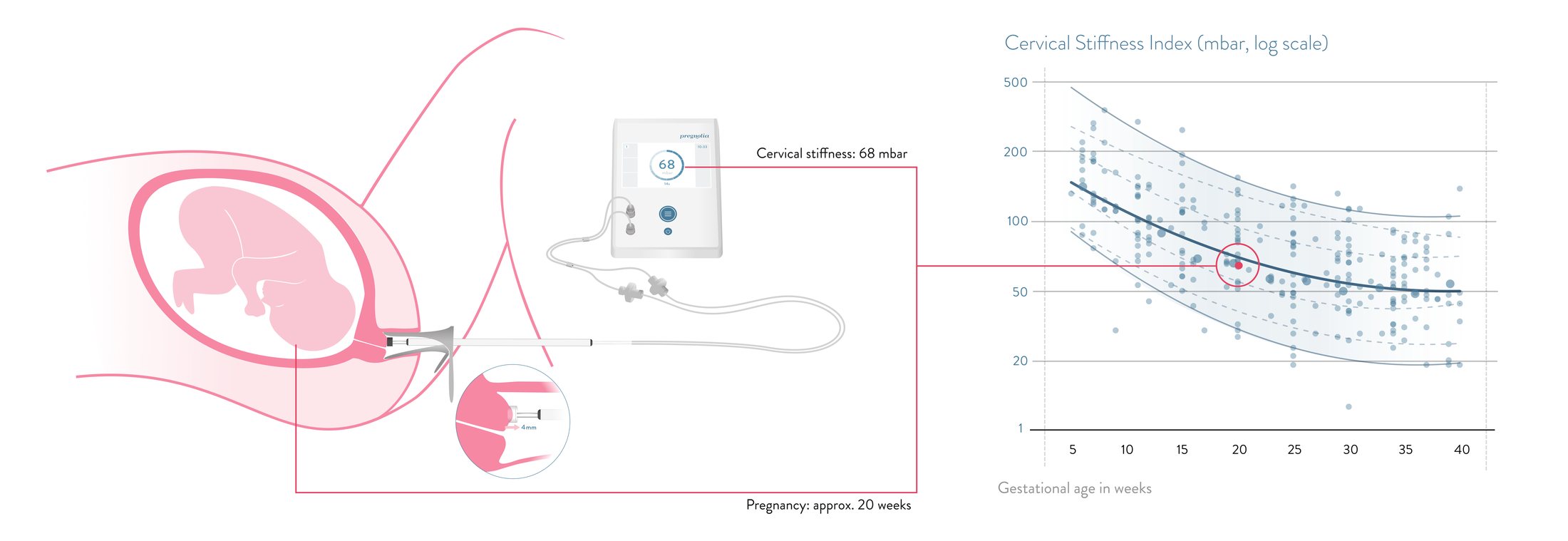
The Pregnolia System consists of a single-use sterile probe and a control unit. The probe is placed in contact with the anterior lip of the cervix with the help of a speculum.
Operating the foot switch creates a small vacuum inside the probe tip, which gently pulls on the tissue. The softer the tissue, the weaker the vacuum required to deform it by 4 mm.
Within a few seconds the control unit displays the cervical stiffness index (CSI) as a negative pressure value (pcl, in mbar). Using the reference curve, the value is compared with percentiles from physiological pregnancy.
What current clinical findings show
More reliable than palpation
Quantitative determination of cervical stiffness is more reliable than digital palpation. [2]
Softening comes first
The cervix softens before it shortens. [1]
Remodelling
Cervical stiffness gives relevant information about cervical remodelling. [1]
Study areas
Physiological, high-risk and symptomatic pregnancies, and induction of labour.
- Badir S. et al. Cervical softening occurs early in pregnancy: characterization of cervical stiffness in 100 healthy women using the aspiration technique. Prenatal Diagnosis 2013; 33(8): 737-741.
- Badir S. et al. Aspiration technique-based device is more reliable in cervical stiffness assessment than digital palpation. BMC Pregnancy and Childbirth 2020; 20(391).
- Parra-Saavedra M. et al. Prediction of preterm birth using the cervical consistency index. Ultrasound Obstet Gynecol 2011; 38: 44-51.
- Baños N. et al. Mid-trimester cervical consistency index and cervical length to predict spontaneous preterm birth in a high-risk population. American Journal of Perinatology Reports 2018; 8(01): e43-e50.
- Baños N. et al. Mid-trimester sonographic cervical consistency index to predict spontaneous preterm birth in a low-risk population. Ultrasound in Obstetrics & Gynecology 2018; 51(5): 629-636.
- Breuking S.H. et al. Assessment of cervical softening and the prediction of preterm birth (STIPP study); a prospective cohort study. American Journal of Obstetrics and Gynecology 2025.
Request a quote
For hospitals, practices and distribution partners in selected European markets. The team in Schlieren replies directly.